Low-fidelity retention signals in the mobile-first barber booking environment.
Behavioral fingerprinting logic injected via a sovereign API-to-Platform interface.
Consolidated franchise scaling via automated client retention and utilization logic.
Franchise-calibrated ADI designed to optimize retention across multi-chair locations.
theCut's Intelligence Ceiling
theCut processed over $2 billion in barber transactions and became the most trusted booking platform in Black and Brown barbershop culture. But between the booking and the chair, an entire universe of behavioral intelligence is being generated — and systematically discarded. This is a strategic audit of what comes next.
A direct address to theCut leadership and enterprise barber operators navigating the AI transition.
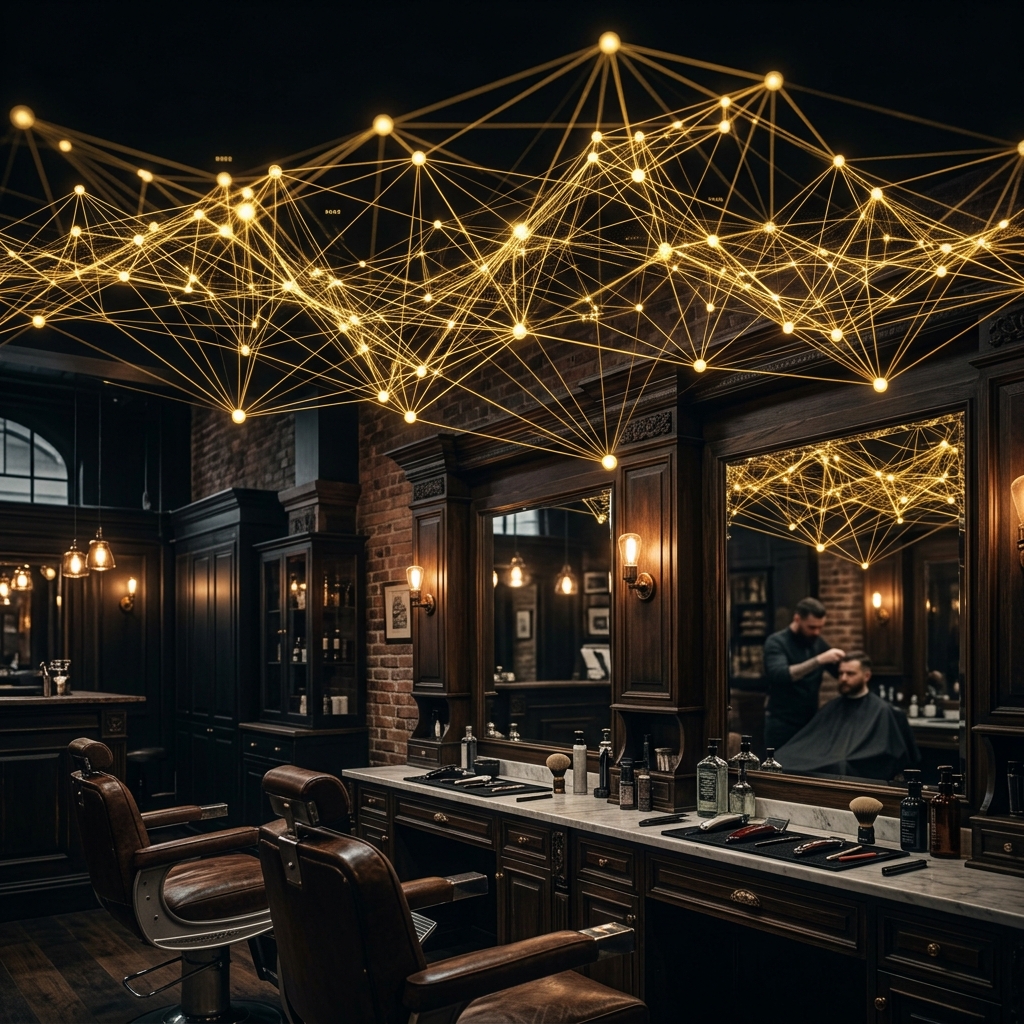
This document is written with genuine respect for what theCut has accomplished. Founded in 2016 by Obi Omile Jr. and Kush Patel — two engineers who understood the barbershop as both a business challenge and a cultural institution — theCut built something rare: a technology platform that earned trust inside one of the most relationship-driven, cash-forward, tech-resistant industries in America. Processing over $2 billion in barber transactions across a network of tens of thousands of professionals and millions of clients is not a product launch. It is a movement. But this document is not about the movement that has been built. It is about the intelligence layer that the movement is ready for — and what theCut is uniquely positioned to do about it.
Part I: The Cultural Infrastructure of a $5.8B Industry
The U.S. barbershop industry generated an estimated $5.8 billion in revenue in 2024, with the broader global male grooming market valued at over $81 billion and projected to exceed $110 billion by 2030. This is not a niche category. It is a growth market with a deep cultural infrastructure, a fiercely loyal consumer base, and — until recently — almost no technology layer worth naming.
theCut entered this gap with a barber-native approach that generic salon software had consistently failed to execute. Rather than adapting a multi-service scheduling platform to barbering, theCut was architected from day one for the specific workflow, payment culture, and client relationship model of the barbershop. The result was organic, community-driven adoption that no enterprise sales motion could have manufactured. When approximately 70% of barbershops now use online booking software and 77% of barber appointments are booked digitally, theCut positioned itself at the center of that transition for the demographic it was built to serve.
The strategic question this document asks is not whether theCut earned its place. It unambiguously did. The question is: what does the platform that owns the booking relationship become, when it has a decade of behavioral data and no model trained on it?
Part II: The $2 Billion Signal — and the Model That Doesn't Exist Yet
Every transaction that flows through theCut is a behavioral data point. Every booking preference, cancellation pattern, no-show event, returning client signature, seasonal visit frequency, service selection, and tip behavior is encoded in the platform's data layer. Across tens of thousands of barbers and millions of clients, this constitutes one of the most granular behavioral datasets in the consumer grooming industry. It is, in the language of machine learning, an extraordinary cognitive feedstock.
And yet: there is no domain intelligence model trained on it. The data is used to populate dashboards. It generates monthly recaps. It reports on revenue and appointment trends. But it does not learn. It does not predict. It does not act autonomously on behalf of the barber who generated it. The $2 billion in processed transactions has produced historical records — not institutional intelligence.
The No-Show Tax: A Quantified Revenue Drain
Barbershops without predictive systems face no-show rates of 15–25% per day. Industry benchmarks indicate rates as high as 21% in unmanaged schedules. Each no-show costs a barber between $25 and $80+ in lost service revenue and tips — before accounting for the opportunity cost of a peak-hour slot that could have been proactively filled. For a barber doing 8 appointments per day, a 20% no-show rate represents approximately $50–$120 in daily revenue exposure. Annualized, that is $18,000–$44,000 per chair in recoverable revenue that no-show prediction could address. theCut has the behavioral data to build this model. The model does not yet exist.
"A barber doesn't lose a client the day they stop booking. They lose them three visits earlier, when a behavioral signal appeared in the data that no one was watching."
Part III: The Closed Garden — Constraint or Competitive Moat?
theCut operates as a fully closed platform. There is no public developer API. No external integrations. No third-party data access. This is a deliberate architectural decision, not an oversight — and it reflects a legitimate strategic instinct: control the data, control the relationship, control the experience. This approach has served the platform well in its growth phase.
However, the closed architecture creates a strategic paradox as the industry matures into the AI era. The very data that the closed garden protects is the feedstock that a sovereign intelligence model requires. Without a data partner architecture — a structured, governed pathway for barbers and shop owners to extract intelligence from their own operational data — the closed garden begins to look less like a moat and more like a ceiling.
The Closed Platform Paradox
Consider the strategic position of a barber with five years of client data inside theCut. That data represents: the exact rebooking cadence of every loyal client, the no-show fingerprint of every at-risk account, the seasonal revenue curve of the business, the service evolution preferences of the clientele, and the operational performance benchmark of every hour, every day, every year.
None of that data is portable, actionable as a trained model, or available in a format that a sovereign intelligence system can ingest. The barber generated it. The barber cannot benefit from the intelligence it could produce. This is not a criticism of theCut's data security posture — it is a market gap observation about the next product category the platform is positioned to own.
- ✕ Barber data generates intelligence exclusively for the platform
- ✕ No-shows managed reactively, not predicted
- ✕ Client retention is manual and barber-dependent
- ✕ Zero IP accumulation for the professional on the platform
- ✕ Platform migration destroys all behavioral history
- ✓ Barber-owned intelligence model trained on their clientele
- ✓ No-show prediction 48–72hrs ahead of the appointment
- ✓ Autonomous re-engagement at the individual client level
- ✓ Intelligence survives any platform change
- ✓ theCut becomes the platform that bestows intelligence, not just booking
Part IV: What a Barber Artificial Domain Intelligence Actually Looks Like
A Barber ADI is not a chatbot response system or a scheduling plugin with a smarter algorithm. It is a fine-tuned, barber-native intelligence model trained on the specific behavioral data of a professional's client base — their cadence, their preferences, their seasonal patterns, their risk signals — and deployed as an invisible intelligence layer that acts on behalf of the barber without replacing their craft or their relationships.
The Barber ADI works with theCut, not against it. It learns from the platform's data stream, enriches it with additional cognitive feedstock sources — Google Reviews, intake preferences, social engagement signals, product purchase history — and returns actionable intelligence back to the barber through whatever interface they already use. The chair experience is unchanged. The intelligence operating above it is not.
The Client Rebooking Window Model
Every client has a behavioral rebooking signature — a preferred cadence that can be modeled from historical booking data. The ADI identifies this window per client (e.g., Client A books every 3 weeks, Client B every 5 weeks, Client C every 3 weeks but lapses in August and October). It sends a contextual, personalized message at the optimal moment within that window — not a generic blast to a segment. A barber with 200 active clients, each detected at their personal rebooking threshold, sees a material improvement in retention without any change to their daily workflow.
Predictive No-Show Intelligence
The behavioral fingerprint of a client who will no-show is detectable in the data before the appointment. Signals include: first-time booking (highest no-show risk category), rescheduled multiple times, booked during an atypical time window, no prior deposit history, and low engagement in the pre-appointment reminder sequence. An ADI trained on theCut's no-show corpus can score each upcoming appointment and surface the top-risk slots to the barber by 48hrs out — giving them time to proactively confirm or fill the chair before the revenue window closes.
The Cognitive Grooming Profile
Each client in the barbershop carries an implicit grooming intelligence profile: preferred service mix, fade tightness preference, beard treatment history, scalp sensitivity notes, life event patterns (pre-interview cuts, graduation, wedding), and emotional context signals. The ADI synthesizes these across all available sources — booking notes, client messages, service history, review language — to build a continuously updated grooming intelligence record. This is not a CRM note the barber forgets to fill in. It is a model learning autonomously from every interaction.
Generative Client Communication
When re-engagement requires a message, the ADI does not pull a template. It generates a contextually calibrated prompt based on the specific client's profile: their last service, the time elapsed, their known preferences, and the most effective message tone for their behavioral archetype. A client who always leaves a tip and books every three weeks gets a different communication than a client who has rebooking history and tends to lapse in winter. The difference between a template and a sovereign intelligence response is the difference between a broadcast and a conversation.
The Platform Inversion — theCut as the Intelligence OS
Today, theCut is a booking platform. In the ADI era, the most powerful position available to the platform is to become the intelligence infrastructure that every barber professional runs their business through — not just a scheduling app, but a sovereign cognitive operating system for the grooming professional. The enterprise that builds the Barber ADI doesn't just improve retention metrics. It becomes the infrastructure standard that a $5.8 billion industry operates on. The platform that owns the intelligence is the platform that cannot be replaced by a cheaper booking app.
Part V: Governance First — Why the Framework Matters More Than the Model
The barbershop context introduces a governance consideration that enterprise SaaS typically ignores: the AI system in a barber professional environment touches client relationships that are built on trust, personal history, and cultural respect. A model that sends the wrong message to the wrong client at the wrong time does not just fail a KPI. It damages a relationship that took three years to build. Governance is not a compliance checkbox in this context. It is the product.
Inner G Complete architects every Barber ADI engagement under the CPMAI (Cognitive Project Management for AI) framework — the PMI-certified governance standard that enforces mandatory Go/No-Go decision gates between phases, Trustworthy AI requirements at every stage, and formal business KPI verification before any model touches a live client relationship.
Business Understanding
Define the barber AI objective precisely. Establish revenue recovery KPIs, retention KPIs, and relationship quality guardrails. Three-gate Go/No-Go decision before any data work begins.
Data Understanding
Audit available behavioral data from theCut's export layer, supplementary sources (Google Reviews, intake forms, payment history). Score data readiness. Identify any data quality gaps.
Data Preparation
Design the cognitive feedstock pipeline. Normalize booking, transaction, and client communication data. Establish training/validation split. Document inclusion/exclusion logic for model integrity.
Model Development
Select base architecture for Barber ADI. Fine-tune on barbershop-native behavioral corpus. Integrate generative communication layer. Define ensemble strategy for retention + revenue models.
Model Evaluation
Verify technology KPIs (accuracy, precision, recall on no-show prediction). Verify business KPIs independently (retention rate change, revenue recovery, relationship quality). Hard gate.
Operationalization
Deploy intelligence layer above existing booking interface. Install model drift detection. Define quarterly stewardship review with the barber or shop owner. Document client communication guardrails.
"In the barbershop, the intelligence that matters is not the intelligence that is most accurate. It is the intelligence that earns the barber's trust and the client's confidence simultaneously. That requires governance that most AI implementations never consider."
Part VI: The Business Case for Sovereign Barber Intelligence
The financial argument for a Barber ADI is available on three distinct axes. Each one stands independently. Together, they represent an ROI case that any professional operating at the intersection of craft and entrepreneurship will immediately recognize.
No-Show Revenue Recovery
With no-show rates at 15–25% for unmanaged schedules, and each no-show costing $25–$80 in lost revenue, a barber serving 8 clients per day faces $18,000–$44,000 annually in recoverable revenue exposure per chair. An ADI targeting a 30% reduction in no-show events through predictive slot management recovers $5,400–$13,000 per year per barber — without a single change to their booking workflow.
Retention-Driven Revenue Compounding
Industry data shows that loyalty programs can improve client retention by up to 20%. A barber with 200 active clients at $65 average service value, retaining 20 additional clients annually through intelligent re-engagement, generates $1,300/year in retained recurring revenue — before considering the referral multiplier each loyal client carries. This compounds annually as the model learns each client's optimal re-engagement window with increasing precision.
Platform Differentiation — theCut as Intelligence Infrastructure
For theCut as an organization, the ADI partnership represents an opportunity that no booking feature can create: becoming the platform that actively compounds the barber's enterprise value. A theCut that offers sovereign intelligence — where the barber owns the model, not just the booking log — is not competing with generic scheduling apps. It is in an entirely different product category. The barbers who generate the most data will actively choose the platform that converts that data into their competitive advantage.
Part VII: A Direct Address to theCut Leadership
An Open Strategic Memo — To Obi, Kush, and the theCut Team
What you built is rare. Building a technology platform that earns trust inside the barbershop — a space that has historically and justifiably been skeptical of every technology company that showed up with a pitch — is the kind of achievement that cannot be manufactured with a growth budget. It requires founders who understood the culture from the inside, built for it without condescension, and earned adoption by delivering genuine value without extracting dignity from the professionals they served.
This document is not a competitive analysis. It is a thesis: theCut is holding one of the most valuable intelligence datasets in consumer grooming — and the next product milestone is not a new feature. It is a new category. The platform that sits on $2 billion in barber transaction history and activates a sovereign intelligence layer on top of it does not just win market share. It becomes the operating standard for an industry.
The closed platform architecture that protected this data during the growth phase is now the constraint that must be thoughtfully redesigned — not opened to the public, but opened to a governed intelligence architecture that allows the barbers and shop owners on the platform to extract compounding value from the data they generated. The difference between a data silo and a sovereign intelligence corpus is a governance framework. That is exactly what we build.
The conversation we are proposing is not transactional. It is architectural. We would begin with a Phase I Audit: a structured, non-binding assessment of theCut's data infrastructure readiness, the ADI model architecture best suited to a barber-native deployment, and the governance framework required to make it trustworthy for the professionals it would serve. No build commitment. Just clarity.
The barbershop has always been the place where community intelligence was shared, preserved, and passed down. The ADI is simply the architecture that makes that intelligence institutional, compounding, and sovereign.
Is Your Barbershop on the Sovereign Path?
Our CPMAI Phase I Audit determines whether your current booking data infrastructure can support a proprietary Barber ADI — and what the architecture, timeline, and ROI would look like to get there. No build commitment required.