Esthetician and manicurist are their own separate TDLR licenses with their own separate exams — but most licensing guides only cover barber and cosmetology, leaving these two paths thin on real information.
Pass a written and practical exam, both administered by PSI on behalf of TDLR — the same exam vendor and two-part format used for barber and cosmetology licensing.
Shorter school-hour requirements than a full cosmetology license, for a more specialized scope of practice.
A canonical reference to how these two exams are actually structured, sourced directly from TDLR — cross-linked to our full license-requirements guide for the broader application/renewal/reciprocity details both paths share.
Texas Esthetician &
Nail Technician
Exam Guide
How the Texas esthetician and manicurist (nail technician) licensing exams actually work — format, vendor, and what each license does and doesn't cover — sourced directly from TDLR.
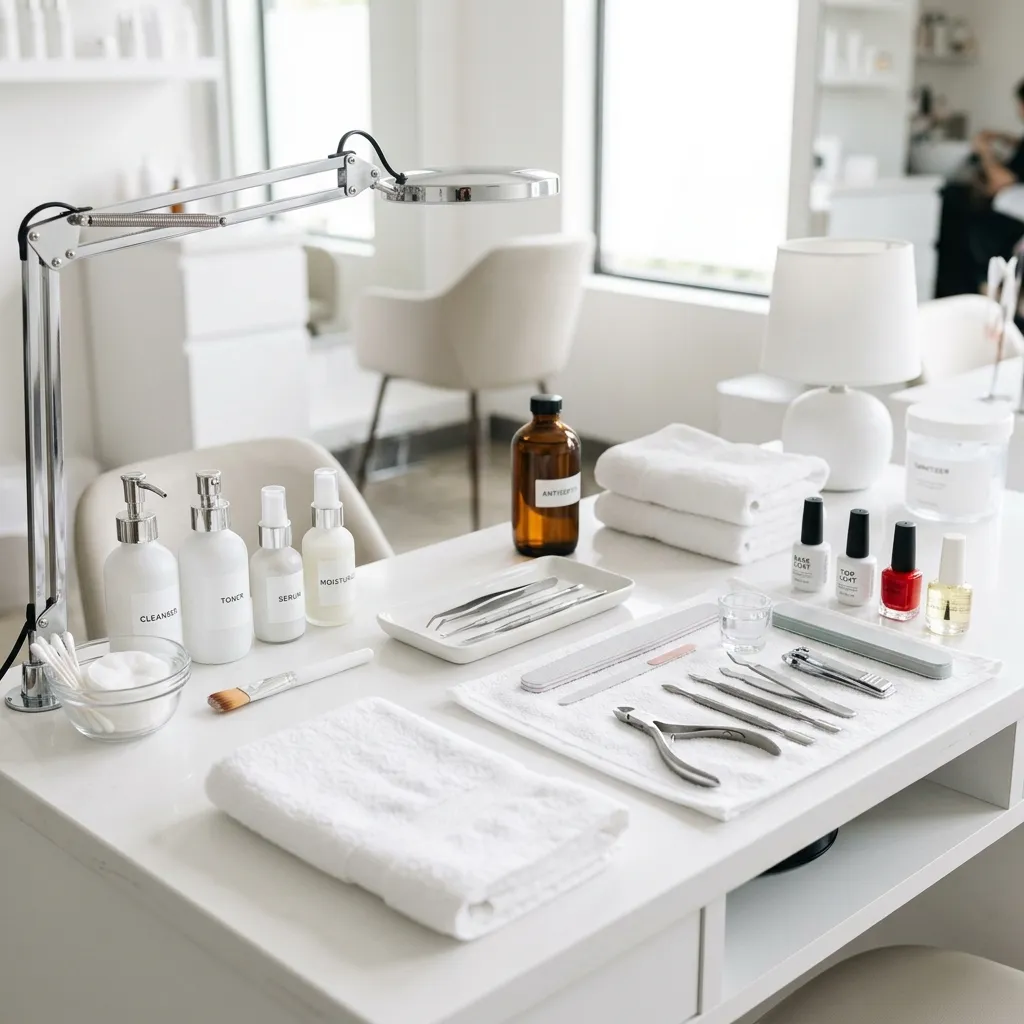
The Esthetician Exam
An esthetician license requires 750 hours of training, versus 1,500 for a full cosmetology license — a shorter, more specialized path if your goal is skincare, waxing, and lash/brow services rather than hair cutting or chemical hair services.[1]
Like every other Texas barbering-and-cosmetology license, the esthetician exam is two parts — written and practical — both administered by PSI on behalf of TDLR. The written portion covers skin analysis, sanitation and safety, and the theory behind facial and hair-removal treatments; the practical portion has you demonstrate real technique on a model or mannequin under a proctor.
For the full comparison of esthetician vs. cosmetologist scope of practice, application steps, renewal cycle, and continuing education — all of which work the same way across both licenses — see our Texas Barber & Cosmetology License Requirements guide. This page focuses specifically on the exam itself.
The Manicurist (Nail Technician) Exam
A manicurist license — what most people mean by "nail tech license" — is its own distinct TDLR credential, separate from both cosmetology and esthetics. It covers manicures, pedicures, and artificial nail services, and follows the same TDLR structure as every other license on this page: school hours, a student permit, then a written and practical exam administered by PSI.[2]
The written exam covers nail structure and disorders, sanitation and infection control specific to nail services, and product/chemical safety (acrylics, gels, and the solvents used with them). The practical exam has you perform real manicure/pedicure and artificial-nail procedures under a proctor, the same way the practical portions of the barber, cosmetology, and esthetician exams work.
Exam Structure at a Glance
| License | School Hours | Exam Format | Exam Vendor |
|---|---|---|---|
| Esthetician | 750 hours | Written: 75 scored items, 105 min, 70% to pass Practical: 1 hr 41 min, 76 points (54 to pass) | PSI |
| Manicurist | Set by TDLR's current rules | Written: 60 scored items, 90 min, 70% to pass Practical: 1 hr 21 min, 51 points | PSI |
Exam figures are taken directly from the January 2026 PSI/TDLR Candidate Information Bulletins.[4][5] School-hour minimums are set by TDLR and can be updated by rule — confirm the current requirement directly with your school or TDLR before enrolling.
Written Exam Content Outline
PSI publishes the exact topic weighting and question count for each license in its Candidate Information Bulletin. This is the single most useful thing to study against, because it tells you where the questions actually are. Both exams are closed book, and both include a small number of unscored pilot items that do not count toward your result.
Esthetician — 75 scored items, 105 minutes, 70% to pass
| Topic | Weight | Questions |
|---|---|---|
| Facial Treatments | 28% | 21 |
| Infection Control | 25% | 19 |
| Licensing and Regulation | 20% | 15 |
| Skin Care | 16% | 12 |
| Hair Removal | 11% | 8 |
Plus 7 non-scored pilot items and 10 additional minutes. Note what is not here: the standalone esthetician written exam contains no nail-care or makeup questions. Guides that list nail topics under “esthetician” are describing the separate combined Manicurist/Esthetician license.
Manicurist — 60 scored items, 90 minutes, 70% to pass
| Topic | Weight | Questions |
|---|---|---|
| Nail Care | 41% | 25 |
| Infection Control | 34% | 20 |
| Licensing and Regulation | 20% | 12 |
| Nail Structure and Analysis | 5% | 3 |
Plus 6 non-scored pilot items and 10 additional minutes. Infection Control alone is a third of the manicurist exam — more than nail structure and licensing combined.
Practical Exam: Tasks & Timing
Every procedure is performed on mannequins, not live models. Tasks must be done in the order listed or they score zero, the time allowed for each section includes setup and cleanup, and closed-toe shoes are required. Scoring is on safety, sanitation, and procedure — and a separate block of safety criteria is scored throughout.
| Esthetician Section | Time |
|---|---|
| Pre-Exam Set Up and Disinfection | 10 min |
| Cleansing | 14 min |
| Steaming | 7 min |
| Massage | 17 min |
| Mask and Moisturizing | 17 min |
| Waxing with Soft Wax | 14 min |
| Blood Exposure Incident | 12 min |
| End of Exam Disinfection | 10 min |
| Total | 1 hr 41 min |
| Manicurist Section | Time |
|---|---|
| Pre-Exam Set Up and Disinfection | 10 min |
| Manicure | 15 min |
| Tip Application on One Nail | 12 min |
| Nail Enhancement with Form | 22 min |
| Blood Exposure Incident | 12 min |
| End of Exam Disinfection | 10 min |
| Total | 1 hr 21 min |
A “Blood Exposure Incident” section appears on both exams — you are scored on correctly handling an exposure, so it is a graded procedure, not a hypothetical.
What the Exams Cost
| Item | Esthetician | Manicurist |
|---|---|---|
| Written examination (PSI) | $55 | $55 |
| Practical examination (PSI) | $76 | $76 |
| Both exams | $131 | $131 |
Exam fees are paid to PSI and are not refundable or transferable. A separate fee is required for each attempt, and your fee is forfeited if you do not test within one year of the date PSI receives it. TDLR charges its own licensing fee on top of these — see our license requirements guide for those. Figures current as of the January 2026 bulletins; older guides still list $50 and $72.
Eligibility, Order & Retakes
You must pass the written exam before you can sit for the practical. They are not interchangeable and cannot be taken out of order.
Once TDLR approves your eligibility, that eligibility is good for five years, and you may test an unlimited number of times within that window. There is no cap on attempts and no mandatory waiting period written into the bulletin — but each attempt carries its own fee, so retakes are limited by cost rather than by rule.
If you fail the written exam, the emailed score report includes a diagnostic breakdown of your strengths and weaknesses by exam topic. That report maps onto the content outline above, which makes it the most efficient thing to study from before a retake.
How to Prepare
Because PSI administers the same exam format across every Texas barbering-and-cosmetology license, the most reliable prep strategy is the same regardless of which license you're testing for: study directly from your school's curriculum (it's built to the same content outline TDLR and PSI use), request PSI's current Candidate Information Bulletin for your specific license type before test day, and treat the practical exam with the same seriousness as the written — a strong written score doesn't offset a failed practical.
Our esthetician and manicurist practice questions cover the Licensing and Regulation and Infection Control domains — 45% of the esthetician written exam and 54% of the manicurist exam — because for those topics the Candidate Information Bulletin itself is the source, and every answer is verifiable against the bulletins linked on this page.
We deliberately do not publish skin-science, product-chemistry, or nail-anatomy practice questions. PSI builds those from Milady Standard Esthetics Fundamentals, Milady Standard Foundations, and Pivot Point Fundamentals: Esthetics — texts we don't hold. Writing questions and attaching textbook citations we haven't verified would be worse than publishing nothing, so for those domains we still point you to your school's curriculum. Our full decks for barber and cosmetology are Milady-sourced end to end.
Try a Real Practice Question
In the graded Blood Exposure Incident section of the Texas esthetician practical, what is the correct order of steps?
Sourcing & Currency
Every exam figure on this page — fees, question counts, time limits, topic weightings, practical task order and timing, and point totals — is taken directly from the January 2026 PSI/TDLR Candidate Information Bulletins, linked in full below so you can verify any number yourself. Remaining figures come from TDLR's own barbering-and-cosmetology pages. PSI reissues these bulletins periodically and TDLR can change requirements by rule, so always confirm your specific license type's current bulletin before test day — several widely-circulated guides still quote the pre-2026 $50/$72 fees and an outdated esthetician content outline. For application, renewal, reciprocity, and continuing-education details common to every license type on this page, see our full license requirements guide.
Frequently Asked Questions
Inner G Complete Agency architectures are built explicitly to exceed the governance and ethical constraints defined by these global standard-bearing organizations.

Lamont Evans
|Principal AI Architect & FounderLamont Evans is a certified CPMAI (Cognitive Project Management for AI) professional specialized in architecting sovereign intelligence layers for the wellness and grooming sectors. He focuses on the intersection of agentic workflows and proprietary domain-specific models, ensuring every deployment is institutionally auditable and built for long-term ownership.
Related in Technical Brief
Highest Paying Barbershops in Houston: Best Pay Terms, Real Listings
Not earnings data — the real terms that actually determine what you keep: the lowest booth rents and highest commission splits among Houston barbershops currently reporting pay structure.
Read MoreBooth Rent Taxes & Do You Need an LLC in Texas?
Booth renters are independent contractors, not employees — what that means for deductions, 1099s, and self-employment tax, and why Texas doesn't actually require an LLC to rent a booth.
Read MoreHow Long Does Barber School Take in Texas? (And Why There's No Apprenticeship Path)
Barber school in Texas requires 1,000 hours — typically 6-9 months full-time. Texas has no barber apprenticeship pathway at all, but there's a real 300-hour accelerated path for licensed cosmetologists.
Read MoreReferences
Texas Department of Licensing and Regulation (TDLR) (2026). Apply for an Esthetician License. TDLR.Texas.gov. Visit Source
Texas Department of Licensing and Regulation (TDLR) (2026). Barbering and Cosmetology — Individuals. TDLR.Texas.gov. Visit Source
Texas Department of Licensing and Regulation (TDLR) (2026). Search / Verify Licenses or Projects. TDLR.Texas.gov. Visit Source
PSI Services LLC / Texas Department of Licensing and Regulation (TDLR) (2026). Texas Esthetician Candidate Information Bulletin. PSI Services LLC. Visit Source
PSI Services LLC / Texas Department of Licensing and Regulation (TDLR) (2026). Texas Manicurist Candidate Information Bulletin. PSI Services LLC. Visit Source