Every barber and cosmetologist choosing a chair asks 'is booth rent or commission better' — and almost every answer online is generic advice with no real numbers behind it.
A real breakeven comparison: at what weekly revenue does a flat booth rent actually beat a commission split, using live pay-structure data instead of guesses.
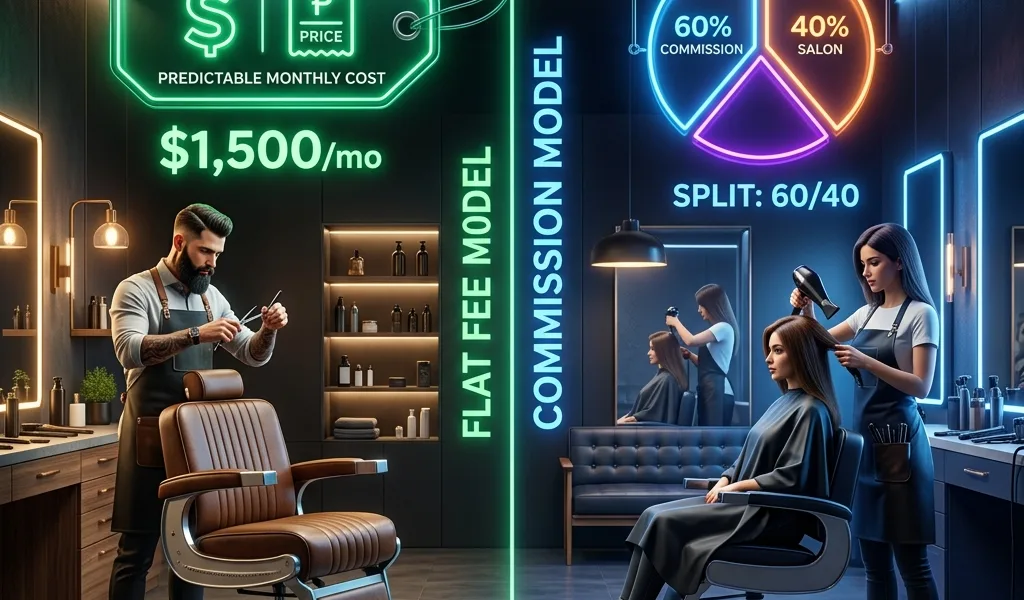
Median Houston booth rent: $180/week. Breakeven revenue: ~$450/week at a 60/40 split.
Live Houston barbershop rent and commission data, reduced to one number — the revenue point where each model wins — plus a calculator using your own numbers.
Booth Rent vs.
Commission
Which pay structure actually nets you more — decided with real Houston barbershop data, not generic advice, plus a calculator that runs the math on your own numbers.
Two Common Myths, Checked Against the Real Data
Myth
"Commission is the standard, safer default in this industry."
Reality
In our live Houston dataset, booth rent outnumbers commission roughly 10 to 1. It's the dominant model here, not the riskier alternative — commission is actually the less common structure in this specific market.
Myth
"One pay structure is objectively better than the other."
Reality
Neither wins outright — there's a real, calculable revenue crossover point (~$450/week at this market's median rates) below which commission pays more, and above which booth rent does. The right answer depends on your own consistent weekly revenue, not a universal rule.
How Booth Rent Actually Works
Under booth rent, you pay the shop a fixed fee — usually weekly — for your chair, regardless of how much you bring in that week. Everything above that fee is yours. Across real, currently-active Houston barbershop listings on this platform, weekly booth rent ranges from $125 to $300, with a median of $180.[1]
Booth rent is by far the dominant model in this market: of the Houston shops in our dataset with a classified pay structure, roughly 10 use booth rent for every 1 that uses straight commission — which tracks with why "booth rent" so heavily outweighs "commission" in what people actually search for.
How Commission Actually Works
Under commission, there's no fixed fee — the shop takes a percentage of what you bring in, and you keep the rest. Splits vary, but the commission-model shops in our Houston dataset cluster around a barber keeping 50–65% of revenue, with 60/40 (barber/shop) the most common single split.
Commission carries less downside risk in a slow week — you never owe more than you make — but it also caps your upside in a strong week in a way booth rent doesn't, since booth rent's fee stays flat no matter how busy you get.
The Real Breakeven Math
Both models pay out identically at exactly one revenue point — below it, commission nets you more; above it, booth rent does. Using this market's median rent ($180/week) against its most common commission split (60%), that breakeven point is:
~$450/week
Gross revenue breakeven at $180/wk rent, 60% commission split
In plain terms: if you're confident you'll consistently bring in more than roughly $450/week in services, booth rent likely nets you more over time. If your weeks are inconsistent or you're still building a book, commission's built-in downside protection may be worth more than the extra upside booth rent offers on a strong week.
Once you know which structure fits you, see which real Houston shops currently list the lowest booth rent and highest commission splits to barbers — not customer pricing, the actual pay terms.
Booth Rent ($180/wk flat)
$420/wk kept
Commission (60% split)
$360/wk kept
At $600/week, booth rent nets you $60 more per week. Your breakeven point — where both models pay identically — is $450/week in gross revenue at these rates. Above that, booth rent wins; below it, commission wins.
Sourcing & Sample Size
Booth-rent figures are drawn from real, currently-listed weekly rates across Houston barbershops tracked on this platform — not a survey or a national average. The commission-split figures come from a smaller sample of commission-model shops in the same dataset, since booth rent is the dominant structure in this market; treat the exact split percentage as directionally right rather than a precise industry-wide figure. Both figures update as more shops report their pay structure.
Frequently Asked Questions
Inner G Complete Agency architectures are built explicitly to exceed the governance and ethical constraints defined by these global standard-bearing organizations.

Lamont Evans
|Principal AI Architect & FounderLamont Evans is a certified CPMAI (Cognitive Project Management for AI) professional specialized in architecting sovereign intelligence layers for the wellness and grooming sectors. He focuses on the intersection of agentic workflows and proprietary domain-specific models, ensuring every deployment is institutionally auditable and built for long-term ownership.
Related in Technical Brief
Highest Paying Barbershops in Houston: Best Pay Terms, Real Listings
Not earnings data — the real terms that actually determine what you keep: the lowest booth rents and highest commission splits among Houston barbershops currently reporting pay structure.
Read MoreBooth Rent Taxes & Do You Need an LLC in Texas?
Booth renters are independent contractors, not employees — what that means for deductions, 1099s, and self-employment tax, and why Texas doesn't actually require an LLC to rent a booth.
Read MoreHow Long Does Barber School Take in Texas? (And Why There's No Apprenticeship Path)
Barber school in Texas requires 1,000 hours — typically 6-9 months full-time. Texas has no barber apprenticeship pathway at all, but there's a real 300-hour accelerated path for licensed cosmetologists.
Read MoreReferences
Inner G Complete Agency (2026). Live Houston Barbershop Booth-Rent & Pay-Structure Data. Inner G Complete Platform (agent_barbershop_leads). Visit Source
Texas Department of Licensing and Regulation (TDLR) (2026). Mini-Establishment (Booth Rental) FAQ. TDLR.Texas.gov. Visit Source